Customized Mobility Solutions for AGV & Autonomous Systems
Selecting the right components for autonomous platforms is a critical engineering decision. At Ubetter, we specialize in customized mobility solutions designed specifically for the rigorous demands of AGV and AMR systems. Led by a 15-year industry veteran with a background in premier German engineering, we bridge the gap between standard catalog products and the precise kinematic requirements of modern robotics.
Why Robot Mobility Customization Matters
Standard mobility components often fall short of the technical rigors required for autonomous flight. Our customized mobility solutions empower engineers to:
Optimize Rolling Performance: Tailor tread profiles for specific floor types to reduce drag.
Enhance Turning Radius: Fine-tune swivel offsets for superior maneuverability in tight spaces.
Improve Operational Stability: Ensure consistent ground contact even during rapid acceleration.
Turn Mobility into an Asset: Move beyond catalog limitations to meet exact chassis performance targets.
Chassis-First Interface Engineering
We adopt a “chassis-first” mindset, ensuring that the mobility system integrates seamlessly into your robot’s unique anatomy. We support our partners through:
Flexible Mounting Configurations: Custom top-plate designs to match existing bolt patterns.
Compact Integration: Low-profile housing for robots with restricted vertical clearance.
Redesign Cycle Reduction: Early-stage CAD support to prevent mechanical interference.
Seamless Compatibility: Ensuring a perfect fit between the drive modules, wheels, and frame.
Rolling Resistance & Battery Efficiency
Rolling resistance is a silent killer of operational endurance. Ubetter helps extend mission durations and lower the total cost of ownership by:
Advanced Material Optimization: Selecting high-rebound polyurethane compounds to minimize energy loss.
Precision Bearing Selection: Utilizing low-friction, high-quality bearings for smoother rotation.
Motor Load Reduction: Lowering the “break-out” force required to initiate movement.
Thermal Management: Reducing heat generation within the wheel during continuous, long-duty cycles.
Suspension Design & Sensor Protection
Vibration from uneven industrial floors can degrade sensitive LiDAR and navigation sensors. Ubetter develops customized suspension structures that:
Enhance Terrain Adaptability: Ensure constant wheel-to-floor contact on uneven surfaces.
Protect Onboard Electronics: Dampen high-frequency shocks that cause hardware failure.
Maintain Movement Precision: Eliminate “sensor noise” caused by excessive chassis vibration.
Extend Component Lifespan: Reduce the mechanical stress placed on the robot’s internal frame.
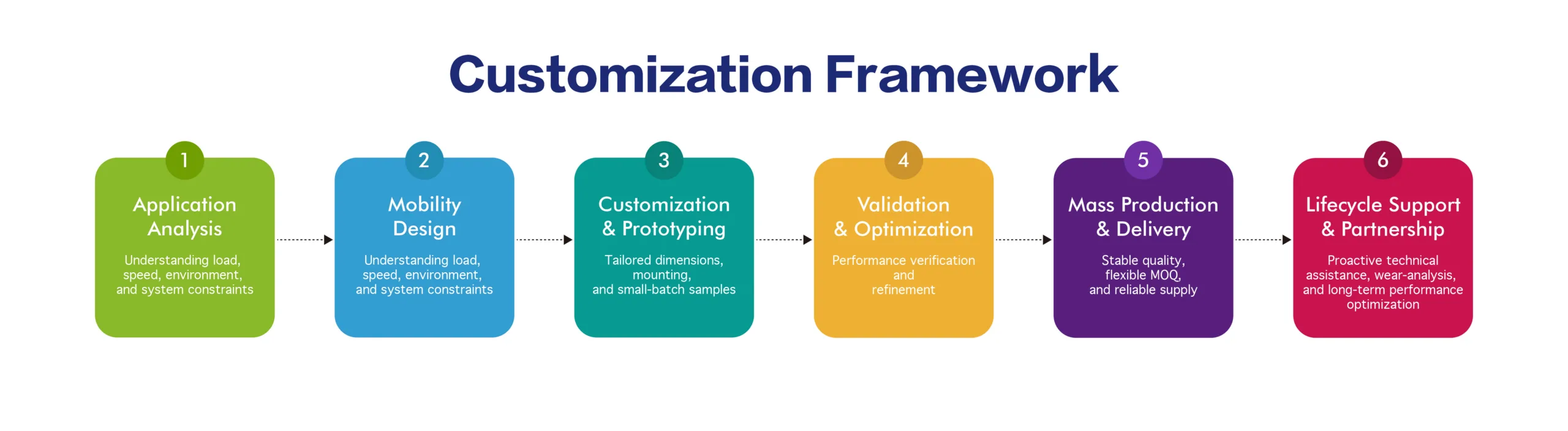
The Ubetter 6-Stage Customization Framework
A systematic approach ensures that every mobility solution we deliver is optimized for the long-term reliability of your autonomous system. Here is how we move from initial concept to high-volume partnership:
1. Application Analysis: We don’t just ask for load requirements. We analyze your robot’s duty cycle, floor surface friction, and thermal constraints to identify the specific kinematic challenges of your environment.
2. Mobility Design: Our engineering team selects wheel geometries and advanced polyurethane compounds that balance rolling resistance with the need for high-precision navigation and positioning.
3. Customization & Prototyping: We provide rapid prototyping and small-batch samples—including custom mounting interfaces and specialized dimensions—to ensure perfect mechanical integration before full-scale deployment.
4. Validation & Optimization: Every prototype undergoes rigorous performance verification. We analyze “break-out” force and damping efficiency to refine the solution for maximum system endurance.
5. Mass Production & Delivery: Leveraging our integrated manufacturing partnerships, we provide stable quality control and flexible MOQs (Minimum Order Quantities) to support your scaling needs from pilot to mass market.
6. Lifecycle Support & Partnership: Our commitment doesn’t end at delivery. We provide proactive technical assistance and wear-analysis to help you optimize the long-term performance and maintenance cycles of your robot fleet.
Frequently Asked Questions: Robot Mobility Engineering
Q: How do I select the right wheels for a 500kg+ AGV payload?
A: Selection depends on more than just load; it requires analyzing starting torque and tread shore hardness to ensure the motors aren’t overstrained while maintaining precise navigation grip.
Q: What is the best way to protect sensitive LiDAR sensors from floor vibration?
A: We recommend integrated shock-absorbing suspension castors. By tuning the spring rate to your specific payload, you can dampen high-frequency vibrations that cause “sensor noise.”
Q: Can Ubetter provide CAD files for chassis integration?
A: Yes. We provide detailed 2D/3D CAD support during the early design stages to ensure our customized mobility solutions fit perfectly within your robot’s frame.